


As valuable as vegetation is, it usually needs to be managed in some fashion. Sometimes to build new, we must clear the old — trees, saplings, bushes and fields for new construction. Other times we need to manicure overgrown right-of-ways or remove forest storm damage. In many of these cases, a compact track loader with a mulching head attachment is an excellent solution for vegetation removal (brush or trees as thick as about 8 in.).
“There are some niche applications for mulching heads, such as fire break clearing,” says Bill Schafer, product development supervisor for Loftness. “However, we find that the biggest users of these products are contractors who clear right-of-ways along roadsides, utility lines and pipelines. If you’re looking to buy a new compact track loader for this type of work, most of today’s manufacturers build exceptional machines to handle mulching heads.”
A compact track loader is a great machine for the abrasive job of brush cutting. Sometimes called rubber track loaders or multi-terrain loaders (depending on the manufacturer), these compact loader/tool carriers are engineered just like skid steers (including the same attachment plate), but with the added versatility of a dedicated track undercarriage. Rolling on rubber or steel tracks, track loaders can spearhead operations and navigate jobsites with extra flotation and balance — in the wet weather and on hilly, uneven terrain.
NOTE: There are dedicated track loader brush cutting machines from the likes of PrimeTech, Rayco and Fecon, but they will not be discussed in this article (just the attachment options for track loaders).
“Whether it’s eradication of an invasive plant species or wildfire fuel reduction in drier climates, new uses and opportunities for these attachments are constantly surfacing,” explains John Wilkins, sales representative with Valley Tool & Mfg. (makers of the RockHound and BrushHound attachment brands). “Those uses, in turn, have a direct impact on which track loader is selected. Many factors such as size, weight, horsepower and cost must be considered to make sure the appropriate selection is made.”
First off, make sure the compact track loader’s lifting capacity and front, auxiliary hydraulic system matches the mulcher. Some manufacturers offer units for both standard- and high-flow compact track loaders, but the latter is more popular because high-flow hydraulic systems are more effective. Talking about compact track machines, forestry mulchers can require flows from a minimum of 13 gpm (standard flow) all the way up to the heavier, high flow that requires up to 45 gpm. Of course before operating, the track loader itself should have a comprehensive protection kit (brush cutting requires serious safety precautions). Here’s a common checklist of safety equipment: an exhaust cover to prevent debris entering the engine bay; cab-glass reinforcement and metal mesh covers; front work light protection; a loader hydraulic hose and auxiliary coupler guards; air conditioning; FOPS guard with side protection; and a cooling pack guard.
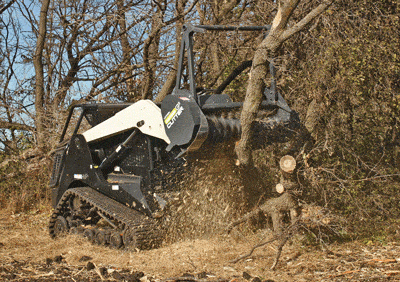
specifically cutting down trees.
“More is better in today’s world. Safety must be priority number one, which is why we make the mulching door mandatory,” explains Giorgio Carera at FAE (a top mulching brand). “When operating, never mulch toward anything or anyone that could be damaged or hurt. If in question, stop. No job is worth damage to equipment or injury to personnel.”
When it comes to picking a safe brush cutting attachment, many different types of heads are available on the market today (each manufacturer is a little different). Your buying decision needs to be based on the application (your customers’ needs), operating costs (fuel and consumable knife costs) and maintenance requirements (time). For light brush and maintenance mowing, there are the rotary, deck-type mowers with two large swinging blades, but they tend to be less effective in heavier material.
For this article, we will focus on mulching heads designed for heavy-duty brush shredding applications, such as land clearing for fire breaks, real estate development and right-of-way maintenance. In this arena, horizontal drum rotors with fixed cutters have emerged as the most popular type of head. The fixed teeth always maintain the correct angle of attack, and the material size you can handle is limited only by available horsepower and the size of the equipment carrying the head. Units often come in common sizes such as 60, 66, 72, 76 and 90 in.
“Our most popular sizes are the 66- and 76-in. models, mainly due to available horsepower and lifting capacity,” says Wilkins. “Unlike mower-specific applications, the need to match or exceed the track width is not as essential because of the general size and height of the vegetation being processed.”
The quest for a brush cutter starts with a rugged mulching head, designed for high-performance cutting and mulching of vegetation, saplings and undergrowth. Consider technologies like a dual-speed motor to reduce risk of stalling, an in-line cooler, which will reduce the heat in the hydraulic system, or a mulcher with a hydraulically-operated front hood. Inspect the unit overall for strong bearings, pulleys and belts to match the higher power and efficiency of the process itself.
“There are a variety of cutting tool options to maximize performance on the job,” says Schafer. “Heavy-duty users may also want to upgrade to variable-displacement motor options. These motors automatically adjust RPM and torque to accommodate various loads.”
A single-bolt retention system for switching mulcher teeth is also great for quick replacements. You can choose between teeth as well — like replaceable carbide tips or ax/chipper-style sharpened blades. Probably the most widely accepted standard in the industry would be the configuration using replaceable carbide teeth spinning in a downward sweep. The downward rotation assures a positive feeding of material as the carbide tips grab and pull the cut material into the shredding chamber. Within each category, there might also be specialized teeth — one perfect for cutting trees, working around rocky conditions or focusing on cutting only Palmettos in Florida. You can customize your teeth configurations, like a model that offers chisel teeth as a top-level arrangement if you would like to have the ability to process vines and soft woods aggressively. There are even reversible teeth that allow for double tooth life.
“There is a tooth for any application from small brush to large trees and rock to land mines,” explains Carera, “but it’s not just about teeth. When judging a mulcher overall, it must be operator and maintenance friendly. The folks in the field have to be happy. Always ask your dealer to go into the details of the product. Some mulchers are built better than others, and you can see the main differences from the design, welding quality, thickness of the frame, rotor structure, push frame strength, counter blades design and a lot of other details that will make the difference in the daily operation, from productivity and operational costs to safety.”

Comments are closed.
I am looking for a mulcher to fit a 100 hp. Massey Ferguson.